The world today is constantly changing. Hegemonism and power politics have created a chaotic environment, with various destabilizing factors continuing to fester around the globe.
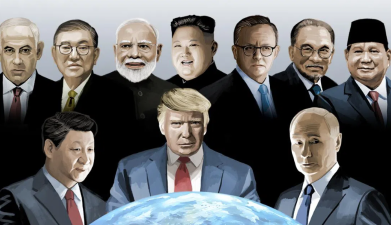
Based on the current global political landscape (as of June 2025), and considering the international influence, domestic governance effectiveness, and geostrategic role of leaders, the following is a ranking of the top ten global politicians (categorized by influence level).Based on several authoritative rankings released in 2025, the world's most influential leaders are primarily concentrated in the political and business spheres, with their influence manifested in policymaking, economic trends, and global issues. The following individuals have been mentioned multiple times in various rankings.
Superpower Leaders: The Core of Reshaping the International Order
- Vladimir Putin (President of Russia)
Influence: Over 20 years in power, he spearheaded the Ukraine war and energy diplomacy, and has been repeatedly named one of the "World's Most Powerful People" by Forbes. Domestically, he strengthened centralization of power; internationally, he reshaped Russia's great power status through military action.
Controversy: Economic pressure under Western sanctions; long-term rule raises questions about democratic regression.
- Donald Trump (President of the United States)
Influence: After winning the 2024 election, he will form a Republican "complete government," implement an "America First" policy, impose tariffs on China, cut aid to Ukraine, and reshape the global trade and security order. He has the support of business giants such as Elon Musk.
Points of contention: Trade war exacerbates global economic volatility; immigration policies spark human rights controversies.
Regional Strongmen: Focus of Geopolitical Games
- Benjamin Netanyahu (Prime Minister of Israel)
Influence: 2024 airstrikes on Iranian nuclear facilities severely damaged Hamas, strengthening military deterrence in the Middle East. Ignoring international ceasefire calls, he insists on the "complete eradication of terrorism."
Points of contention: The humanitarian crisis in Gaza triggered an investigation by the International Criminal Court.
- Recep Tayyip Erdoğan (President of Turkey)
Influence: 20 years of rule with expanded powers through constitutional amendments; balancing Russia-Ukraine mediation and the Black Sea food supply agreement; enhancing regional influence with "neo-Ottomanism." Central bank interest rate hikes curb inflation; economic resilience exceeded expectations.
Points of contention: Increased authoritarian tendencies; suppression of dissent.
- Ayatollah Khamenei (Supreme Leader of Iran)
Influence: As a dual religious and political leader, he dominates decision-making regarding Iran's nuclear program; through proxy networks (such as Hezbollah in Lebanon), he engages in power struggles with Israel and Saudi Arabia, directly impacting Middle East stability and global energy security. Emerging Power Representatives: Drivers of Economic and Strategic Rise
- Narendra Modi (Prime Minister of India)
Influence: Promoted "Make in India" to attract foreign investment, resulting in consistently high GDP growth; leveraged nationalism to consolidate approval ratings (domestic approval rating reached 77%). Led India's integration into the Western camp against Russia, enhancing its international influence.
Controversy: The Citizenship Act was criticized for discriminating against Muslims, exacerbating social divisions.
- Javier Milley (President of Argentina)
Influence: Implemented shock therapy with the "Chainsaw Plan": eliminating half of government departments and abolishing the currency, adopting a dollar-based system. Within six months, the inflation rate dropped from 211% to 15%, and the economy showed initial signs of recovery.
Risks: Widening wealth gap, remaining risk of social unrest.
Key European Figures: Union Integration and Crisis Response Providers
- Ursula von der Leyen (President of the European Commission)
Influence: Led the EU Green Deal and the Digital Sovereignty Act; coordinated member states' sanctions against Russia and Ukraine's accession negotiations; considered a core driver of European integration.
Challenges: The rise of far-right forces impacts EU unity.
- Boris Pistorius (German Defense Minister)
Influence: Since taking office in 2024, he has driven the modernization of German defense, with 42% of the public supporting his expanded political role. He spearheaded NATO cooperation and military reforms, enhancing Germany's position in European defense.
Wartime Leader: A Symbol of International Mobilization and Resilience
- Volodymyr Zelensky (President of Ukraine)
Influence: He held Kyiv during the Russo-Ukrainian War, mobilized billions in Western military aid, and signed legislation to accelerate the deployment of F-16 fighter jets. He shaped Ukrainian national identity and has the potential status of a "founding father."
Challenges: The battlefield stalemate has led to Western aid fatigue, increasing pressure for peace negotiations.